Fig. 01 — node graph / studio overview
§ 01 / studio · available for new work · q3 2026

Software built from data up.

A solo studio designing precise, data-driven applications. Working at the intersection of structure, measurement, and craft.

view
// principles precision clarity signal over noise
Fig. 02 — work index, n=4

A small catalogue of things built carefully.

Each project starts with a question about data — its shape, its motion, what it makes possible when arranged just so.

01 / Zeph
zeph — hourly forecast · run · today
RANGE
▸ today
tomorrow
this week
SPORT
▸ run
cycle
walk
HIIT
best window
6:30 AM 9.2
right now
4.1 wait

Hourly — 64°F • 12mph • UV 5

5acool, breezy5.4
6awarming8.1
6:30apeak window9.2
7aUV climbing7.3
12ptoo hot3.6
Zeph

An iOS coach that scores every hour for your sport — so you run at 6 AM, not noon. Weather, physiology, and your schedule, reduced to one number.
status: live on App Store platform: iOS year: 2026 getzeph.app
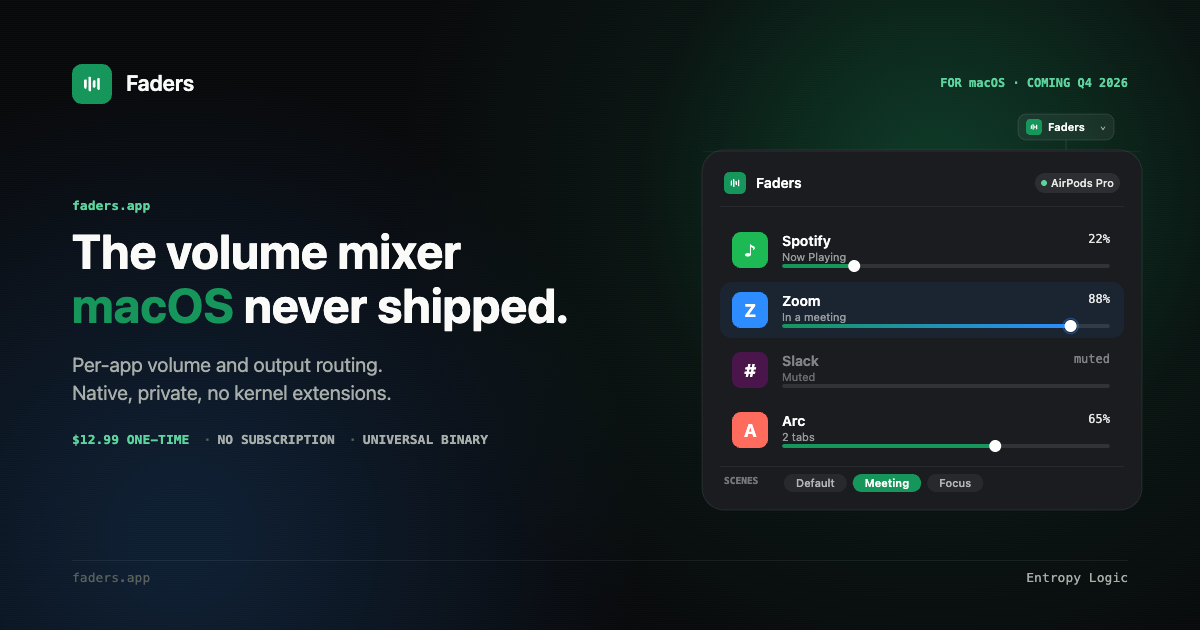
02 / Faders
Faders app screenshot
Faders

Per-app volume control and output routing for macOS. The mixer Apple never shipped — native, sandboxed, no subscription.

status: launching Q4 2026 platform: macOS 14+
03 / Drift
drift — 12 sites watched · 3 changes today
+ apple.com/macbook-pro 09:14
~ stripe.com/pricing 11:02
competitor.io/landing 14:48
· github.com/release-notes
· news.ycombinator.com
Drift

A local website change monitor for Mac. Watches the pages that matter, locally, on your schedule.

status: in development platform: macOS
04 / Huddle
// task hazard analysis
Olive St. Water Main
Trench wall collapse1926.652 Falling material1926.451 Confined space entry1926.1203 Underground utility1926.651(b)
OSHA 1926 · 4 hazards
// toolbox talk
Trench safety — May 19
Shoring required at 5ft depth. Daily competent-person inspection. Atmospheric testing before entry. Egress within 25ft.
5 min · recorded
// crew sign-off
7 of 7 confirmed
gps · hash · timestamp
Huddle

Voice-first task hazard analysis for construction foremen. Run the huddle, get OSHA 1926-aligned paperwork in under five minutes.

status: TestFlight beta platform: iOS output: THA + toolbox + sign-off
Fig. 03 — methodology, comparative

Two ways to build software.

Most teams start at the spec and work their way toward the data. We start at the data and let the spec emerge from what's there.

vs
// the common path

Top-down.

  • A specification is written before anyone has looked closely at the underlying data.
  • Data is forced to fit a model that was decided in a meeting room.
  • Software ships, then is patched as reality reveals the assumptions that were wrong.
  • The interface guesses at meaning the data could have made obvious.
// our practice

From the data up.

  • Begin with the shape of what's actually there — schemas, edges, rates, anomalies.
  • Let structure emerge from observation, not from convention or template.
  • Refine until it reads true: the model and the data agree without translation.
  • The interface becomes a consequence of the structure, not a guess at it.
Rev. 2026.05 — § 04 / ethos

Most software is built top-down, then asked to fit reality. We work the other way around — starting from the data, its shape and its grain, and letting the interface emerge from what's actually there.

A solo practice means fewer projects, taken seriously. Direct collaboration, clear thinking, and the patience to keep refining until the product feels less like a tool and more like an instrument.

Est. 2024 Based remote Practice 1 Projects/yr 2–3